


While Iran and Lebanon dominate the headlines, the situation in the West Bank continues to deteriorate along multiple axes under a combination of: a sustained policy of settlement expansion and annexation-oriented bureaucratic measures; increased fiscal support for settlements, planning efforts, and infrastructure; and continued failure to contain an epidemic of increasingly violent Jewish terrorist attacks. An effective and intensive IDF counterterrorism campaign has prevented an explosion of Palestinian violence in the West Bank thus far, but these negative dynamics have strained the military’s resources through additional deployments to secure new settlements and outposts, while Jewish extremist attacks divert units from their counterterrorism efforts. The worsening situation in the West Bank has furthered the deterioration of Israel’s ties with Europe and drawn EU and individual country sanctions while threatening to interfere with American regional ambitions. The current right-wing religious Israeli government, which has been uniquely permissive of de facto annexationist measures, is unlikely to win the next Knesset elections in fall 2026. Accordingly, these dynamics are likely to worsen over the next few months as the coalition seeks to bank achievements for the election campaign and lock in whatever measures they can now in anticipation of losing power.
Settlement Expansion
The current government has established 103 new settlements from December 2022-June 2026, between retroactively legalized outposts—previously considered illegal under Israeli law—and newly approved localities considered legal under Israeli law from the outset, bringing the total number of official settlements to 230. In the same time period, the number of illegal outposts and “settlement farms,” small outposts designed to maximize control of land via animal grazing and friction with Palestinians, has spiked by at least 157 (122 settlement farms and 35 outposts) to 321. Settlement construction approvals have also surged under the current government, with over 32,000 housing units advanced from the start of 2025 to June 2026, the highest-ever total.
The locations of new settlements and construction approvals are significant. They include: the controversial E1 project filling in the area between Jerusalem and Ma’ale Adumim, which critics argue will practically prevent a contiguous Palestinian state, the re-establishment of four northern West Bank settlements evacuated in the 2005 disengagement, and approval of many new settlements deep in the West Bank. The vast majority of newly approved settlements sit outside the “blocs,” densely populated areas closer to the Green Line which for over two decades have been widely expected to be annexed to Israel under a negotiated two-state outcome. Declarations of state land—a precursor to future settlement expansion—have also increased, amounting to 27.5 square kilometers from 2024-2026.
However, this physical and bureaucratic expansion has not been matched by a surge in population or a clear shift in the settler population to live deeper in the West Bank, both due to supply and demand factors. The settler population remains roughly 5% of the total Israeli population, and the settler migration balance is near-zero. Most growth is natural, driven by a high birthrate in the Haredi settlements, which contain over 35% of the settler population. Moreover, the share of settlers living between the Green Line and the security barrier, close to Israel, continues to hold steady at roughly 76%, as it has for over two decades.
Those who choose to live in the settlements are split between Haredim, who prioritize cheap housing, a homogeneous community, and proximity to Jerusalem; those seeking a higher quality of life in the form of more affordable individual homes and a quieter environment and community; and the ideologically motivated. It is primarily the ideologically motivated who populate the settlements east of the security barrier, which are more disconnected from Israel proper and often less developed and safe than those closer to the Green Line. In other words, most Israelis are not particularly interested in living in the settlements, and even among settlers, the majority do not want to live in isolated settlements deep in the West Bank.
Another factor limiting population expansion is the supply of housing and the bureaucratic process itself. Actually establishing new settlements or building approved construction plans can take years, meaning much of the formal settlement expansion remains on paper for now. The spread of outposts and settlement farms has redistributed the smaller population of more radical settlers throughout the West Bank rather than attracting new residents. However, bureaucratic expansion measures are difficult to undo, and past dynamics are no guarantee of the future.
Deepening Civil Control Over the West Bank
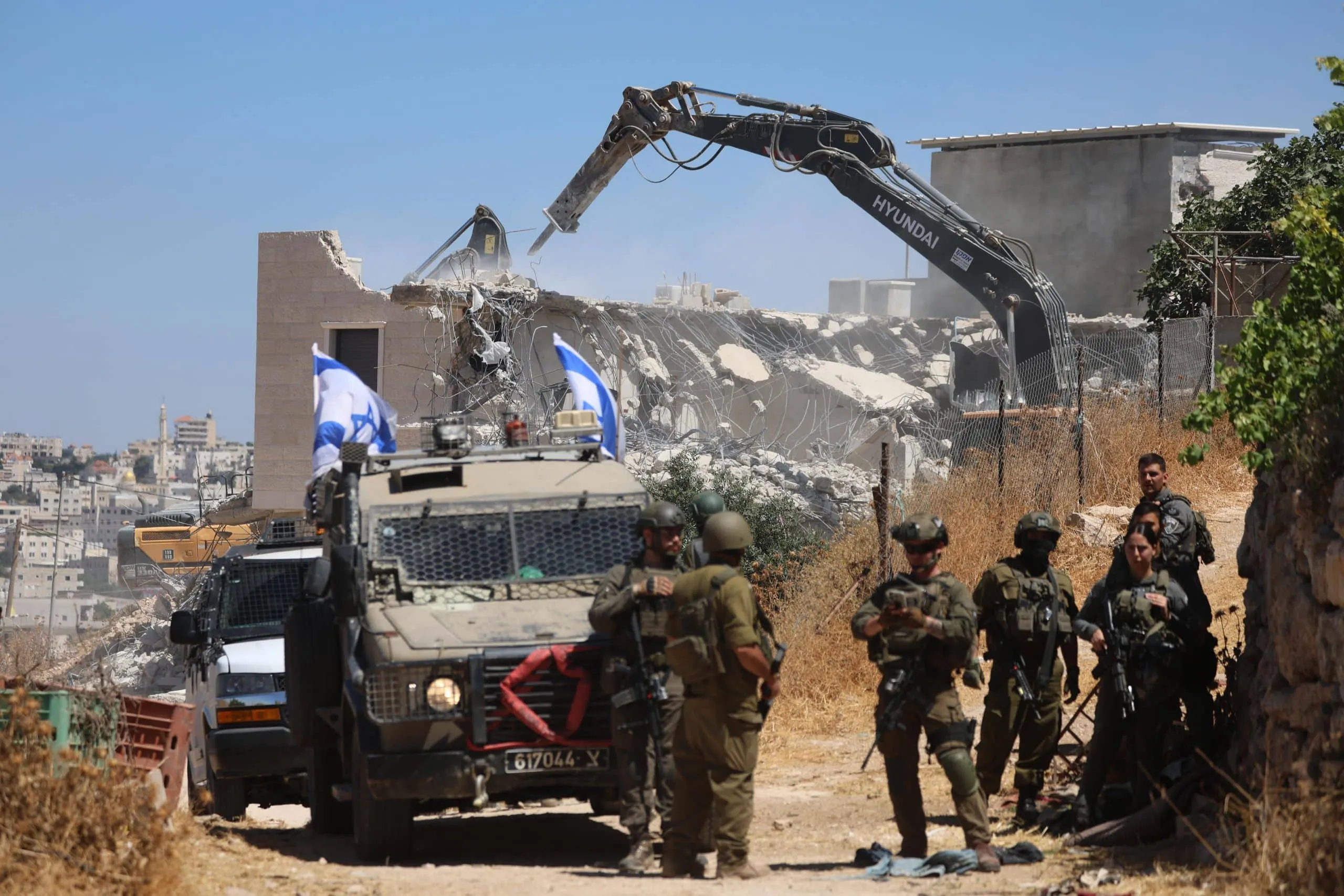
The government has enacted a range of measures designed to deepen Israeli civil control over the West Bank, blurring the line between military occupation and annexation and eroding large parts of the Oslo Accords underpinning Israeli-Palestinian interactions in the West Bank. Among others, these include: restarting the long-paused land registration process, which would delineate between state and privately-owned land in the West Bank and open the door for land purchases by Israelis; asserting authority over archaeological sites and illegal construction in Area B, which is supposed to be under Palestinian civil control according to the Oslo Accords; streamlining settlement planning and construction approval processes; and replacing COGAT (Coordinator of Government Activity in the Territories) and Civil Administration military officials with politically appointed civilians. Other measures include a proposed bill to place West Bank archaeological sites under civilian control rather than military and a recent move to place the Jewish parts of Hebron and holy sites there solely under Israeli administrative control.
Several government ministers, including Finance Minister Bezalel Smotrich and Public Security Minister Itamar Ben Gvir, have clearly and repeatedly articulated a desire for full annexation of the West Bank. While a future government without far-right parties is unlikely to either share this view or place a high priority on advancing de facto annexation, the sweeping changes to Israel’s administration of the West Bank over the past three years mean that many expansionary trends are likely to continue by default at the bureaucratic level, with fewer and more costly opportunities for political intervention. A new government with a full agenda would not be likely to consider undoing Smotrich’s “revolution” in settlement bureaucracy a top issue, nor would they necessarily be familiar with the steps needed to reverse it or interested in enduring a bruising fight with the settlement movement and its allies.
Financial Support to Settlements & Outposts
The Israeli government has substantially increased direct and indirect financial support to settlements, which are almost all net recipients of government benefits anyway. In March 2026, the watchdog NGO Peace Now estimated that the current government had allocated or announced plans to spend roughly NIS 19 billion on the settlements, with the majority of funding going towards road construction (NIS 7 billion), development expenditures in the existing settlements (NIS 6 billion), and a five-year strategic plan for settlement development (NIS 2.6 billion), as well as tourism projects, private security, and specific funding for farms and outposts in the Jordan Valley. In May 2026, an additional NIS 1 billion was approved for road and transportation infrastructure.
A further NIS 1.4 billion was allocated between 2023 and March 2026 via coalition funds, a discretionary budget category wherein funding allocations are determined by agreements amongst the coalition parties, generally targeted towards party priorities. In the 2026 budget, this included NIS 354 million for a wide array of settlement-related items: security grants to local authorities and community security squads (including weapons and vehicles); funding for the Settlement Division of the World Zionist Organization, which conducts land management and settlement development; money for archaeology projects; and more.
The government has also extended unique financial support for new construction, illegal outposts, and even extremist settlers. In June 2026, the government reportedly approved an NIS 1 billion plan to fast-track construction of 61 new settlements, including funding temporary housing and infrastructure before budgets are set for the new localities, and an NIS 125 million plan to promote the planning and legalization of outposts. The government is also weighing a plan to provide NIS 50 daily stipends to “hilltop youth” as part of a largely education-focused anti-radicalization effort.
Other indirect expenses associated with the settlements cannot be easily quantified, primarily the additional cost to the IDF beyond its regular counterterrorism and security missions to protect civilian settlements and roadways, and actions to disrupt clashes between settlers and Palestinians or prevent Jewish terror attacks.
Jewish Terrorism
Jewish terrorism continues to surge in the West Bank, with 1,549 Jewish nationalist attacks in 2024-2025 by the IDF’s count and 3,284 by the U.N. Office for the Coordination of Humanitarian Affairs’ more expansive definition. The attacks span a spectrum of violence, including intimidation, arson, theft of livestock and possessions, assault, and murder, and have not been effectively contained by the IDF, the police, or the court system. While some violence is the result of clashes or confrontations between Israeli and Palestinian civilians, it is more frequently the result of a targeted and sustained campaign of harassment or violence by small and motivated cores of Jewish terrorists, interspersed with pogrom-like larger attacks on villages. The primary goal of such violence is to force the displacement of Palestinians, particularly in remote parts of Area C, and OCHA reports that some 3,600 Palestinians have fled from these areas since January 2025.
The situation has overtaxed the IDF, who themselves were the target of some 10% of Jewish terror attacks in 2026, and distracted them from their primary counterterrorism mission in the West Bank while drawing forces away from other fronts. In March, an IDF battalion had to be diverted from the active warfront in Lebanon to the West Bank to try to stabilize the situation there. The Netanyahu government, which includes two parties broadly supportive of Jewish extremist elements in the West Bank, removed key albeit controversial tools such as administrative detention that the Shin Bet, Israel’s internal security agency, had been utilizing to contain the violence, and lesser measures like house arrests or internal expulsion orders from the West Bank for violent extremists are regularly ignored by those subjected to them. Moreover, the Israeli police under Minister Itamar Ben Gvir have adopted a policy of routinely failing to investigate attacks quickly or thoroughly, which exacerbates and is exacerbated by deep distrust of the police by local Palestinians.
Amid persistent security establishment warnings and mounting international criticism, which has translated into the EU and other Western countries sanctioning a range of settler organizations and leaders alongside specific violent extremists, the government has begun to promote a largely social policy to address the violence. The existing NIS 120 million plan focuses on education of the disaffected youth the government claims accounts for most of the violence and other social policies, rather than enforcing law and order in the West Bank or reliably investigating, arresting, and prosecuting offenders to break the sense of impunity, leading to concerns the funding will actually end up enhancing the often-illegal settlement enterprise that violent offenders come from.
Consequences & Elections
The severe deterioration in the West Bank has not gone unnoticed by the international community. Most of the new sanctions levied on Israel in recent years cite or focus on the situation in the West Bank as justification, and the U.S. has repeatedly expressed frustration over continued Jewish extremist attacks that have killed several Palestinian-American dual citizens in the last several years.
However, the situation is likely to deteriorate further in the run-up to Israel’s next parliamentary elections in fall 2026. The far-right Otzma Yehudit and Religious Zionism parties, some of whose most visible accomplishments from the perspective of their political base in the past three years have been the major expansion of settlements and de facto annexationist measures in the West Bank, will seek to enhance and trumpet these gains to their base. This is particularly true for Religious Zionism, which has been at or under the electoral threshold in most polls for months. Likud, meanwhile, may seek to focus on achievements in the West Bank and Gaza at a time when Israeli gains in Iran and Lebanon appear to be under severe threat and the U.S.-Israel relationship is strained. Opposition parties are likely to do the reverse, honing in on the coalition’s weak spots while largely ignoring the more controversial West Bank policies/challenges.
The current Israeli government’s actions to expand settlements and deepen civilian Israeli control in the West Bank, as well as its failure to contain Jewish extremist violence against Palestinians, have erased the pre-2022 equilibrium, which was negative but significantly more stable. The security requirements and strains on the IDF are increasing alongside the state’s other financial commitments in the West Bank, and the international community’s escalating pressure has normalized measures like sanctions on mainstream settlement organizations and put momentum behind broader efforts at boycotts of goods made in the West Bank. Both on the ground and in international diplomacy, the situation is moving in a negative direction for both Israeli and Palestinian security and prosperity.
Any future government will have to contend with the fuse lit in the West Bank in the past three years. Many expansionist moves are technically reversible, but would require serious political effort that a new coalition, even one led by parties opposed to the current government, might be wary of expending. Arguing against an annexationist measure or settlement expansion before it is passed is politically different from arguing to reverse a decision, even if it remains entirely on paper. Israelis are divided on what state policy regarding the West Bank should be, and though annexation lacks majority support, most Israeli Jews believe settlements have an important security role. Though there are many areas in which Israeli policy could be altered to advance a peace process, Israel cannot manufacture peace without a credible Palestinian partner willing to redefine the Palestinian national movement. That stagnation has long proved fertile ground for the settler movement to drive developments on the ground simply by acting while the mainstream prefers to defer resolving the issue to final-status negotiations. That dynamic allows for reversing expansionist moves to be easily framed as a concession.
Yet these political challenges are not insurmountable, particularly for any government focused on trying to rehabilitate Israel’s international relationships and reduce its security burdens. Moreover, other issues like Jewish extremist violence demand a rapid policy shift both on security and diplomatic grounds. A new Israeli government seeking to redefine it and Israel’s image in the international community has many options to do so by changing West Bank policy and stopping the deterioration there.