


The Asymmetrical Missile-Rocket-Drone Paradigm:
Understanding Israel’s Aerial Threats and Defensive Capabilities
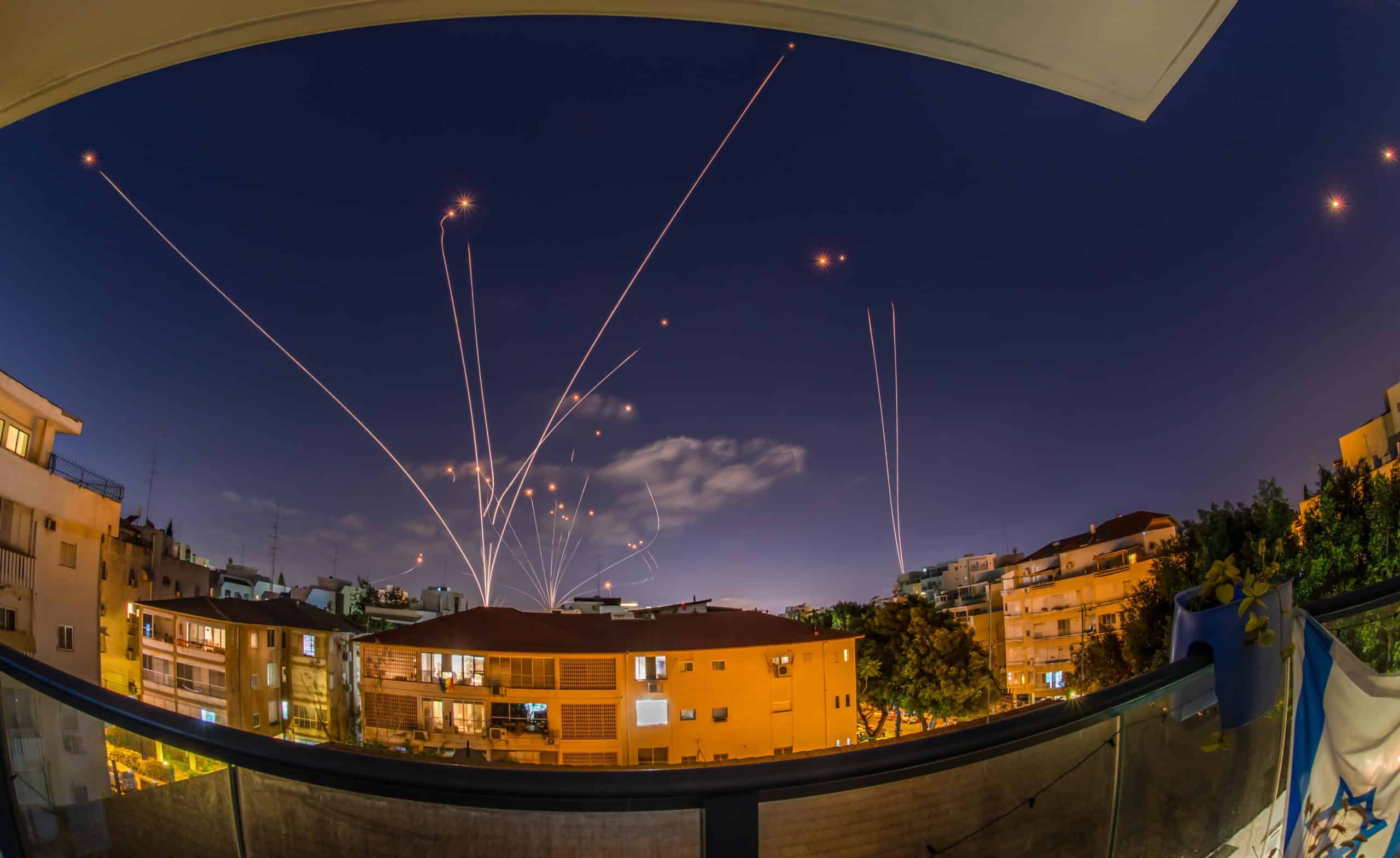
A defining feature of Israel’s threat environment is the large stockpiles of rockets, missiles, drones, and other aerial munitions its adversaries possess, whether in Gaza, Lebanon, Iraq, Iran, or Yemen. While Israel has world-class air defense systems and continues to develop new technological solutions, the missile-rocket-drone paradigm is inherently weighted towards the attacker, presenting a financial and strategic threat to the Israeli homefront. As Israel’s campaigns in Gaza and Lebanon, as well as its strikes in Iran, have demonstrated, offensive countermeasures to destroy enemy rocket and missile stockpiles, launchers, and production facilities can reset the paradigm.
The Ring of Fire: Adversary Capabilities
Israel faces a range of Iran-backed proxies that rely heavily on their rocket, missile, and drone stockpiles to engage in asymmetric warfare against Israel at low cost. Most major groups have dedicated aerial units or arrays to manage their missile and drone attacks, and go to great effort to produce and hide stockpiles and launchers throughout their areas of operation. Since October 7, 2023, these groups have launched over 26,000 rockets and missiles and hundreds of drones at Israel.
Palestinian Militant Groups
Palestinian militant groups in the Gaza Strip possessed significant pre-October 7 rocket stockpiles. While most rockets produced in Gaza are relatively short-range, Israel’s main population centers are within that range. Prior to the war, Hamas held an estimated 12,000-15,000 mostly unguided rockets (other estimates ran as high as 30,000), several hundred of them long-range, and had extensive underground rocket production facilities throughout Gaza. Hamas also has significant quantities of surveillance and suicide drones. Palestinian Islamic Jihad (PIJ) had an estimated stockpile of 6,000-8,000 rockets and missiles, and several of the dozen or so other Gazan militant groups possess dozens to hundreds. Some militant groups also possessed anti-tank guided missiles and shoulder-mounted surface-to-air missiles, which posed a threat to Israeli vehicles and aircraft.
Since October 7, 2023, Hamas, PIJ, and others have launched over 14,000 rockets at Israel, at least 5,000 of them during the October 7 attack alone. Israel’s ground operation in Gaza has succeeded in destroying large quantities of rockets, launchers, and production workshops, and rocket fire from Gaza has dropped sharply, with only 26 rockets fired at Israel in September 2024. In July, media reports cited an IDF claim that Hamas possessed less than 10% of its rocket stockpile, between 1,000 and 1,500 rockets.

Hezbollah
Hezbollah’s pre-war missile, rocket, and drone capabilities—bolstered by extensive Iranian funding, weapons transfers, and technical aid—far exceeded Palestinian militant groups in quality and quantity. The group had an estimated 150,000 rockets and missiles in its arsenal before the war, roughly 10%-15% of them capable of reaching population centers in central Israel. Several thousand are believed to be precision-guided munitions (PGMs). Hezbollah also possesses several thousand drones, including Iranian-made suicide drones, which existing Israeli air-defense systems often struggle to intercept. On top of this, Hezbollah possessed a large quantity of rocket-propelled grenade launchers (RPGS) and ATGMs, which could not be addressed by Israeli air defense systems. Pre-war, Israeli security sources widely acknowledged Hezbollah’s growing and increasingly accurate missile and rocket arsenal as a serious strategic threat.
A year of Israel-Hezbollah cross-border clashes, followed by Israel’s intense aerial campaign and ground operation against Hezbollah, have drastically degraded Hezbollah’s formidable capabilities. The IDF estimates that 80% of Hezbollah’s rocket and missile stores and thousands of launchers have been destroyed, leaving it with less than 100 precision-guided missiles. The IDF also believes it has destoyed 70% of Hezbollah’s drone stockpile. Hezbollah has also launched at least 12,400 rockets at Israel since October 7, 2023 (though Palestinian militant factions in Lebanon likely account for several hundred of that total), along with some 1,300 drones. While Hezbollah’s aerial capabilities have been heavily damaged, it remains a potent military force which has launched over 3,000 rockets and missiles at Israel since the Israeli ground invasion began on October 1, 2024.
Houthis & Iraqi Militias
The Houthis, a Yemeni Iran-backed Shi’a militia, have launched upwards of 220 ballistic missiles, cruise missiles, and drones at Israel, mostly targeting the southern port city of Eilat. The group has also conducted attacks on dozens of ships traversing the Gulf of Aden and Bab el-Mandeb, some of them owned by Israelis, to try and close the Red Sea to international shipping. Israel has conducted two major retaliatory strikes on the Houthi-held port of Hodeidah, targeting fuel depots and power plants without significantly degrading Houthi missile stockpiles (the size of which are unknown).
Iran backs a dense and opaque network of militias in Iraq which have reportedly launched some 150 missiles and dozens of drones at Israel during the war in Gaza. The full capabilities of these militias is not known, and Israel has not publicly retaliated against them.
Iran
Iran has invested heavily in asymmetric warfare, given its comparative weakness in conventional aerial warfare as a result of Western sanctions, and manufactures a wide array of ballistic missiles and attack and suicide drones. The true size of Iranian stockpiles are unknown, but it is estimated to have over 3,000 ballistic missiles and many cruise missiles. Iran also claims to possess a hypersonic missile, the Fattah-1, though analysts have cast doubt on this claim.
Iran has launched two direct aerial attacks on Israel in 2024, and Israel has retaliated twice. The April 13-14 attack combined an estimated 185 drones, 35 cruise missiles, and 110 ballistic missiles to try to overwhelm Israeli defenses. However, thanks to an American-led coalition including the UK, France, Jordan, and Saudi Arabia, many targets were intercepted before getting close to Israel, and Israeli interception efforts took care of the rest, resulting in minor property damage and one serious injury to an Israeli girl from shrapnel. Israel acceded to American pressure to de-escalate, and its April 19 response to the April attack was limited, targeting an S-300 advanced air defense system outside Isfahan.
Iran’s second attack took place on October 1 and consisted of 181 ballistic missiles, of which roughly one-quarter got past Israeli defenses and caused damage to both civilian and military infrastructure while killing a Palestinian man in the West Bank near Jericho. Israel’s response on October 26 was much more extensive, destroying Iran’s three remaining S-300 air defense systems as well as striking sensitive military bases and missile production factories. Israel estimates these strikes eliminated 90% of Iran’s pre-war missile production capability, though it still possesses hundreds of long range ballistic missiles. Iran has vowed a “crushing” response, and if it follows through, the escalatory cycle is likely to continue.
Israel’s Defense Systems
Israel has developed a number of defense systems to deal with this array of aerial threats, often jointly funded by and produced with the U.S. Together, these create a multi-layered, though not hermetic, shield that has protected Israel from the brunt of attacks over the past 15 years. Combined with a country-wide alert system and widespread (yet insufficient) public and private shelters, these systems have saved many lives.
Iron Dome
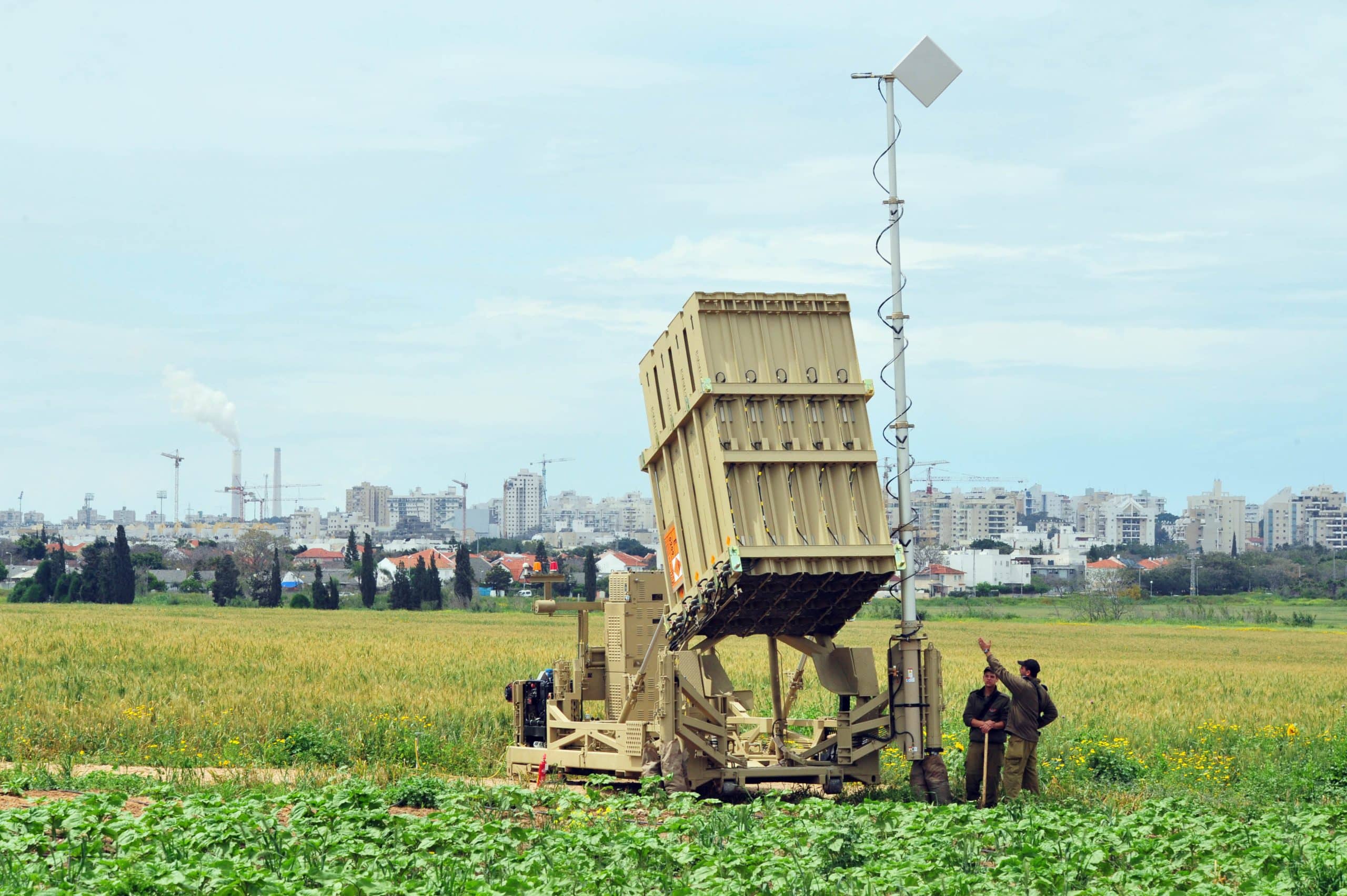
Iron Dome is the best-known Israeli system. Jointly developed by the U.S. and Israel and produced by Israeli defense company Rafael, it became operational in 2011. Iron Dome is a short-range system (150 square km coverage) designed to intercept rockets and mortar fire, and each battery consists of three parts: a radar system, three to four launchers containing 20 Tamir interceptors each, and a command-and-control unit. The U.S. has contributed $2.9 billion since 2011 to the development and deployment of Iron Dome. Israel possesses at least 10 Iron Dome batteries deployed near cities and along the country’s borders. While the costs of both batteries and interceptors are classified, open-source estimates are that each system costs $50-$100 million and interceptors cost $40,000-50,000 each.
Soldiers from the IDF Air Defense Command determine which incoming projectile needs to be intercepted, then fire one or two interceptors that detonate when a proximity fuze triggers within 10 meters of the target, destroying it with a shrapnel cloud. Iron Dome has been refined over the years and performs well against large quantities of fire: on October 7, batteries in Israel’s south reportedly intercepted 90% of incoming fire.
While Iron Dome is land-based, Rafael has developed a naval version called C-Dome, which is used to defend Israeli ships and offshore oil and gas platforms.
David’s Sling
David’s Sling makes up the middle band of Israeli air defense. It is a medium-range system (40-300 km radius, with a max interception height of 15 km) co-produced by Rafael and U.S. company Raytheon, designed to intercept medium-range cruise and ballistic missiles as well as long-range rockets. The U.S. has contributed over $2.4 billion to development of David’s Sling since 2006. The system was deployed in 2017 and conducted its first operational interception in 2023. David’s Sling consists of a radar system, a command-and-control center, the Stunner missile interceptor, and mobile launching units that hold up to 12 interceptors each.
David’s Sling is a terminal-phase hit-to-kill system that destroys its target on its descent by hitting it with the interceptor, using the kinetic energy of the impact instead of a warhead. Each interception costs between $700,000 and $1 million, and while the overall cost of David’s Sling is classified, Israel sold the system to Finland in 2023 for $345 million.
Arrow
Arrow is a family of long-range, high-altitude anti-ballistic missile defense systems for which joint Israeli-American development began in the 1980s. Between 1990 and 2023, the U.S. gave Israel over $4.5 billion in aid to develop and build Arrow systems. Israel operates both the Arrow-2 (deployed 2000) and Arrow-3 (deployed 2017) interceptors. Both Arrow-2 and Arrow-3 use the same fire control center, Green Pines radar system, and launchers (each of which holds six interceptors).
While Arrow-2 uses a fragmentation warhead that detonates within 50 meters of the target and is capable of terminal-phase interceptions at a range of 90 km and a height of 50 km, Arrow-3 is a hit-to-kill interceptor and can carry out exo-atmospheric interceptions at a range of 2,400 km. Arrow-2 interceptors cost an estimated $1.5 million each, while Arrow-3 interceptors cost $2 million apiece. While the cost of both systems is not public, Germany purchased an Arrow-3 system for $3.5 billion in 2023. Israel Aerospace Industries, which produces the Arrow Weapon System, claims Arrow-3 interceptors have been used in dozens of successful ballistic missile interceptions over the past year.
Other Systems
Beyond its marquee systems, Israel uses American-made Patriot missiles (referred to as Yahalom, or Diamond) to intercept some missile threats. The U.S. recently deployed its own cutting-edge THAAD system to Israel to help defend against Iran. The IDF frequently uses jets to manually intercept drones and cruise missiles, and more recently has begun using attack helicopters to visually track and shoot down drones. Recent media reports indicate that the IDF has begun using older Vulcan autocannons, which rapidly fire thousands of rounds, on the border with Lebanon to shoot down drones.
Financial Asymmetry
The missile-rocket-drone paradigm is financially lopsided: defenders fire expensive interceptors at very cheap rockets. Basic mortars and short-range rockets such as Katyushas or Qassam-1s cost only a few hundred dollars to produce, while Iron Dome interceptors, which are relatively cheap, cost close to a hundred times as much. More complex attacks, such as those from Iran, are far more expensive to defend against. Israel likely spent over $550 million and perhaps over $1 billion defending against Iran’s April 13-14 attack, combining the cost of interceptors and deploying fighter jets.
While missile defense is expensive, failure to defend is much more so, both in terms of financial and human cost. The missiles that penetrated Israeli defenses in Iran’s October attack caused at least $53 million in damage to civilian targets alone, while the total damage to civilian property since October 7 is estimated at over $400 million. This does not take into account damage to military infrastructure or the indirect economic cost of failure to defend against aerial assault, which is likely to run much higher.
Defense Challenges
Coverage
Israel’s missile defense systems, while highly effective, do not hermetically protect the country. A certain number of aerial attacks get through, and even successful interceptions can cause damage from shrapnel and falling debris. Therefore, a purely passive approach does not guarantee security.
This is compounded by geography. While Israel is small, large areas are necessarily left unprotected, either because there is not a system in range to protect them or because they are deemed low-priority areas. This includes nearly all agricultural lands, which has resulted in a high number of deaths and injuries among foreign workers and Israeli farmers from attacks in those areas. Areas very close to Israel’s borders, such as the Gaza envelope and towns along the northern border, cannot be protected by Iron Dome because there is not enough time to detect threats and launch interceptors. These border areas are also vulnerable to flat-trajectory fire from RPGs or ATGMs, which cannot be intercepted by air-defense systems and can reach targets as far as 10 km away.
Many towns also have insufficient public shelters and older and unregulated buildings often lack private saferooms. Arab Israeli municipal leaders have charged that their towns are not viewed as high-priority areas or provided sufficient shelters, and there have been several lethal and mass-casualty impacts in towns like Majd al-Krum and Tira.
Supply
Israel has burned through an enormous number of interceptors in the current war, well beyond the rate at which they can be produced, raising concerns about its ability to sustain so-far robust missile defense. The U.S. is Israel’s primary source of arms and has transferred over 50,000 tons of military aid to it, including thousands of interceptors. However, the U.S. defense industrial base is overstretched by the wars in Ukraine and the Middle East, on top of its own needs.
Over half the components of Tamir interceptors are produced in the U.S., though most are fully assembled at Rafael facilities in Haifa. A factory slated to open by 2026 in Arkansas will produce 2,000 full interceptors a year, along with interceptors for American systems. Israel has recognized the need for increased domestic arms production, and the Ministry of Defense has recently signed large contracts with Israeli companies for the new Iron Beam laser defense system and critical ammunition types. However, self-sufficiency with munitions is unlikely, both due to Israeli manufacturing limitations and the fact that the IDF uses many systems for which it does not have production rights.

Complex Attacks & Drones
New technology and techniques present other challenges. Layered (combining drones, rockets, and missiles) and saturation (attempting to overwhelm individual batteries) attacks present a serious threat, though Israel has continually refined its defenses to compensate. The Iranian attack in April, which coordinated the launches of drones, cruise missiles, and ballistic missiles to arrive simultaneously, is unlikely to be the last complex aerial assault Israel faces.
Drones are a unique challenge to intercept for any country, and Israel is no exception. Drones are small and fly low in unpredictable, non-ballistic patterns, which makes them difficult to detect and continuously track on radar. Though the IDF has adopted new techniques to better track and shoot down drones, and claims a roughly 80% interception rate, they are actively seeking out new anti-drone systems.
New Technologies
Israel has invested heavily in new interception technologies. The Iron Beam system is a directed-energy weapon that will destroy incoming projectiles using a 100-kilowatt laser, making it the most powerful such system in the world. The system works by firing two lasers simultaneously at the target, concentrating on a small area to deliver enough energy to eliminate it. It is intended to supplement Iron Dome by shooting down small short-range rockets and mortars, as well as drones.
Iron Beam, which is expected to come online in 2025 after the Israeli Ministry of Defense signed a major production deal with defense company Elbit, has many advantages. The largest is cost: laser interceptions effectively cost only as much as electricity, estimated at $3.50 per shot. Since the system emits a continuous and adjustable laser, it is particularly useful for destroying drones. However, Iron Beam is not a catch-all solution. It has a limited range of 10 km, becomes ineffective when cloudy or rainy weather interfere with the laser, requires several seconds locked on its target to disable it, and cannot conduct simultaneous interceptions. Therefore, it is expected to be used to complement existing systems by being deployed alongside Iron Dome batteries.
A wide array of anti-drone systems, including drone-to-drone interceptors and microwave weapons, are in development, and the Ministry of Defense held trials for several of these systems in October 2024.
Israel’s Ground Operations: Changing the Paradigm
Israel’s aerial defense systems are mitigating measures that are expensive to sustain and do not completely eliminate the rocket, missile, and drone threat posed by Palestinian militants, Hezbollah, and Iran and its other proxies. Fundamentally, the only way to seriously reduce or eliminate this threat is to destroy enemy stockpiles, launchers, and production facilities, usually by combined air and ground operations.
Israel has spent the past year doing this in Gaza and in Lebanon, with significant results. The IDF estimated in July that it had eliminated 90% of Hamas’ rocket and missile stores, and has destroyed hundreds of launchers and dozens of production facilities. In Lebanon, the IDF believes it has destroyed 80% of Hezbollah’s rocket and missile stores, thousands of launchers, and 70% of its drones. However, Hezbollah’s remaining rocket stores are sufficient to maintain high-intensity rocket fire on Israel for months and the group is still a strategic threat. The Iranian threat also remains substantial, and the damage from the October attack illustrates the necessity of improving Israel’s missile defenses.
While Israeli actions have drastically reduced the missile-rocket-drone threat the country faces, the fundamental financial and strategic asymmetry remains. For the foreseeable future, Israel will need to continue to refine its existing defense systems and protocols and develop new ones, expand local production of interceptors, and work to prevent its adversaries from rebuilding their stockpiles. This will require significant investment and military activity.